Strongest Solar Radiation Storm in Two Decades Strikes Earth
 Ashwini Gambo
The Sun has unleashed its most powerful solar radiation storm in more than 20 years, sending charged particles hurtling toward Earth and triggering both dazzling auroras and widespread technological disruptions. Scientists say the event is the strongest of its kind since the infamous Halloween solar storms of 2003.
The severe space-weather event reached Earth on Monday afternoon at around 2:20 pm ET, following a massive solar eruption known as a coronal mass ejection (CME). The blast was triggered by an X-class solar flare, the most intense category of solar flare, and resulted in a Level 4 solar radiation storm on a scale that tops out at five.
According to experts, radiation levels during the storm rivalled those seen in October 2003, when similar solar activity caused power outages in parts of Europe and damaged electrical infrastructure in southern Africa.
A Sun-Fuelled Chain Reaction
The disturbance began when the Sun expelled a vast cloud of magnetised plasma at extreme speed. As the CME collided with Earth’s magnetic field, it generated a severe geomagnetic storm, compressing the planet’s magnetosphere and flooding near-Earth space with energetic particles.
Space-weather forecasters warned that such storms can disrupt satellite operations, GPS accuracy, and high-frequency radio communications, particularly in polar regions. During the peak of the storm, radio blackouts were reported near the poles, forcing airlines operating polar routes to adjust flight paths and communication strategies.
Officials at the National Oceanic and Atmospheric Administration (NOAA) said they worked closely with agencies and infrastructure operators to ensure preparedness across critical systems, from power grids to space missions.
Technology Under Pressure
Modern society relies heavily on satellite navigation, timing systems, and space-based communications, all of which are vulnerable to intense solar activity. Previous geomagnetic storms have caused GPS-guided farming equipment to malfunction, disrupted aviation systems, and increased drag on satellites in low-Earth orbit.
While operators were largely able to mitigate impacts this time, scientists warned that stronger or prolonged storms could still pose serious risks to global infrastructure.
Risks Beyond the Ground
Solar radiation storms also present health concerns for astronauts aboard the International Space Station (ISS). Space agencies closely monitor radiation levels during such events and are prepared to move crews into more shielded areas if exposure increases.
Passengers on long-haul flights over polar regions may also experience slightly elevated radiation exposure during major solar storms, though aviation protocols are designed to minimise risks.
A Global Aurora Spectacle
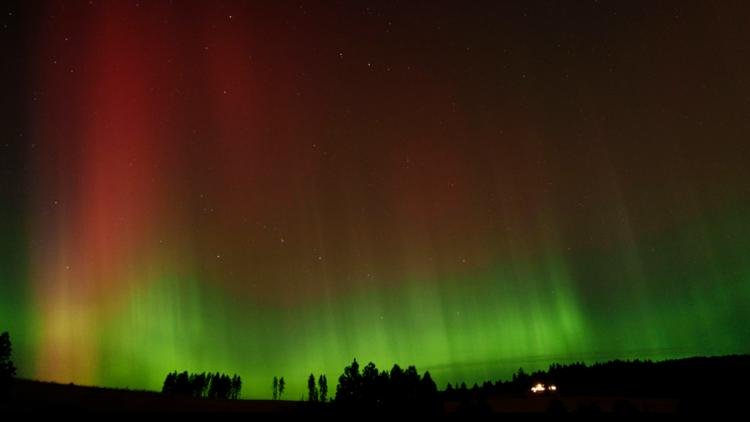
On the brighter side, the storm produced one of the most extensive aurora displays in years. The geomagnetic activity pushed the Kp index to level 8 out of 9, allowing auroras to be seen far beyond their usual high-latitude ranges.
Skywatchers across large parts of the northern United States were treated to vivid displays, with auroras forecast as far south as Alabama, northern California, and the Midwest. The lights appeared in waves, intensifying in short bursts known as substorms, during which auroras became brighter and more widespread.
Looking Ahead
While the storm began easing by early Tuesday, scientists say it serves as a powerful reminder that space weather has real-world consequences. From power grids and satellites to aviation and agriculture, modern life is deeply connected to the Sun’s behaviour.
The good news is that monitoring and forecasting capabilities have improved significantly since 2003. With early warnings from space-weather agencies, industries can take preventive action reducing, though not eliminating, the risks.
As solar activity continues to rise in the coming months, experts caution that storms like this may become more common, underscoring humanity’s enduring vulnerability to the volatile nature of its closest star.