Dubai Adopts Sponge City Model Through Shenzhen Partnership at World Governments Summit
 Ashwini Gambo
Dubai is set to embrace the innovative “sponge city” model an urban planning approach pioneered in Chinese cities such as Shenzhen as part of its drive toward smarter, more resilient, and low-carbon urban development. The model focuses on designing cities that absorb, filter, and reuse rainwater through green infrastructure rather than allowing it to overwhelm drainage systems and cause flooding.
Under the sponge city concept, urban areas function like a giant sponge. Rainwater is captured through green roofs, permeable pavements, landscaped open spaces, and underground storage systems, then slowly released or reused when needed. This approach significantly reduces surface runoff, eases pressure on drainage networks, and enhances urban resilience to climate-related challenges.
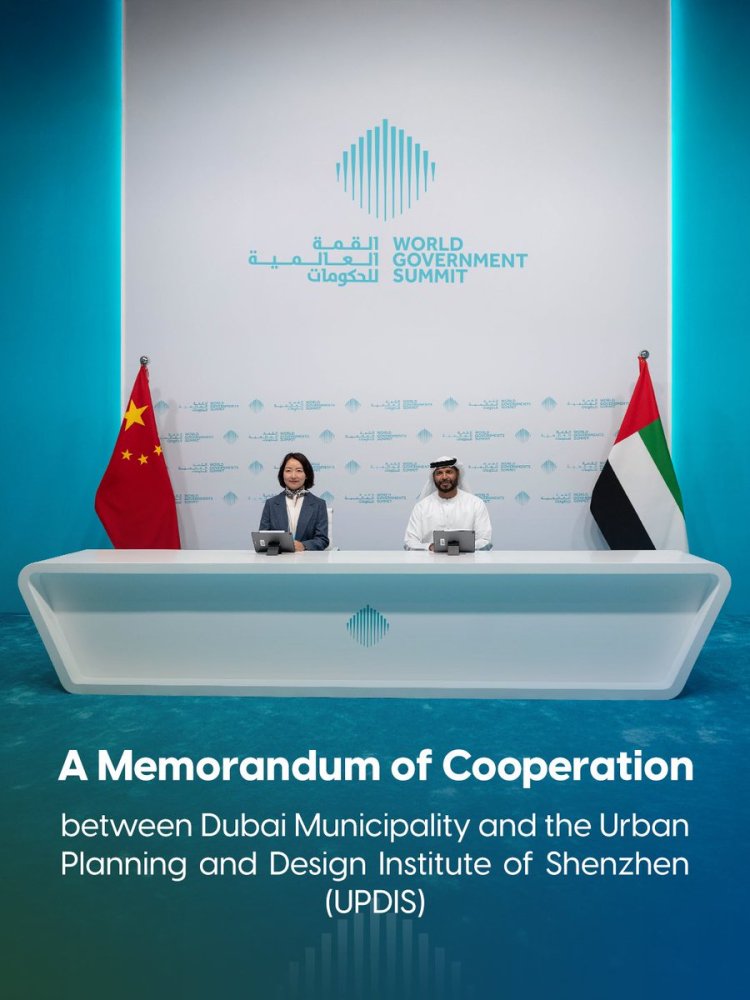
The move follows the signing of a Memorandum of Understanding (MoU) between Dubai Municipality and the Urban Planning and Design Institute of Shenzhen (UPDIS) on the sidelines of the World Governments Summit (WGS) 2026. The agreement marks a major step in bringing future-ready urban concepts and advanced planning practices to Dubai.
A Structured Framework and Shared Vision-
The MoU establishes a structured framework for cooperation focused on urban planning and design, smart and sustainable city development, low-carbon urbanism, and advanced infrastructure systems. Through this partnership, both entities will exchange expertise, align planning methodologies, and collaborate on delivering more resilient, efficient, and people-centred urban environments.
The agreement builds on a high-level Dubai delegation visit to Shenzhen in February 2025, during which officials examined Shenzhen’s experience in sponge city design and smart city applications. The visit highlighted strong alignment between the two cities’ long-term development priorities and urban growth trajectories.
Under the partnership, Dubai Municipality and UPDIS will jointly advance future planning practices and urban design approaches, integrating international best practices with local planning frameworks. This includes collaboration on transit-oriented development, compact and agile urbanism, sponge city concepts, low-carbon city planning, and smart city models.
Building the Future City-
The cooperation also extends to the application of emerging technologies across urban planning, construction, operations, and city management. These efforts aim to support the transition toward intelligent, data-driven urban systems, enhancing sustainability and liveability across the city.
Both parties will work together on deploying advanced spatial analysis tools, artificial intelligence, and data-driven planning techniques, while exploring new global urban development models that combine the experiences of Dubai and Shenzhen. The partnership is positioned as a platform for testing and promoting innovative approaches to future city-making.
In infrastructure development, the MoU outlines collaboration on next-generation ICT systems supported by 5G, integrated underground services, and smart water management systems powered by AI and big data. These initiatives are designed to strengthen the efficiency, resilience, and sustainability of urban infrastructure in response to evolving environmental and technological demands.
Responding to Future Challenges-
Marwan Ahmed bin Ghalita, Director General of Dubai Municipality, said the partnership reflects Dubai’s commitment to learning from global urban leaders while contributing its own planning expertise on the international stage. He noted that the collaboration with UPDIS would strengthen Dubai’s capacity to deliver smart, sustainable, and people-centred urban environments that enhance quality of life and respond to future challenges.
He added that the World Governments Summit provided an ideal platform to formalise the cooperation, bringing together governments and institutions focused on shaping future cities through innovation, resilience, and global collaboration.
Yu Lu, President of the Shenzhen Urban Planning and Design Institute, highlighted the similarities between Shenzhen and Dubai, noting that both cities have experienced rapid urban development and now stand at the forefront of innovation and sustainable growth. He described the MoU not merely as a formal agreement, but as a strategic framework for sustained cooperation between the two cities.
Beyond Technical Collaboration-
UPDIS, which has been active in urban planning and design for over 35 years, also serves as an important platform for international exchange in urban governance, innovation, and technology application. The collaboration is expected to extend beyond technical planning to include personnel training, resource and technology matchmaking, and academic and research exchanges, promoting mutual learning and knowledge-sharing.
The partnership supports Dubai Municipality’s broader mandate to plan, design, and manage the city in line with Dubai’s long-term urban and economic strategies, including the Dubai 2040 Urban Master Plan, while reinforcing Dubai’s position as a global hub for forward-looking urban governance and sustainable development.